Guides
What a mattress guarantee actually covers
A guarantee is not a promise that the mattress will last. It is a promise about manufacturing defects, hedged by thresholds, exclusions and sliding scales that almost nobody reads until they need to.
Ask a salesperson how long the guarantee runs and you get a number. Ask what would actually have to happen before it pays out, and the conversation usually stops.
That second question is the one that matters. The answers are all published, all checkable, and spread across seven sets of terms that no company selling one of them has any reason to compare.
Every figure below comes from the brand’s own UK terms, checked on 29 August 2026. Where something could not be confirmed from a first-party page, that is said rather than filled in.
- The number of years is the least useful thing on the label.
- Ask how deep a dip has to be before it counts. Answers range from 2cm to 7cm.
- Some guarantees pay in full. Others make you buy the replacement at a discount that shrinks yearly.
- Normal softening is never a defect. That is the exclusion that ends most claims.
- Your rights against the shop are separate, and usually stronger.
What a guarantee actually covers
Faults in materials or workmanship. That is the whole of it.
It does not cover a mattress you have gone off, a mattress that has softened, or a mattress that no longer suits you. Comfort preference is explicitly excluded from every set of terms we have read. Simba excludes “normal softening of the Mattress with age”; DreamCloud excludes “normal increase in softness of the foam pressure-relieving material” and “comfort preference” as separate items.12
This is the single biggest cause of rejected claims, and it is not sharp practice. A mattress softening under nightly load is the product doing what it was designed to do. The National Bed Federation goes further and describes body impressions as evidence the mattress is working correctly.3 Readers may want to weigh that it comes from a trade body representing manufacturers, but the underlying point about filling settlement is physically sound and we have seen nothing to contradict it.
A trial covers changing your mind about comfort. A guarantee covers manufacturing defects. They run on different clocks with different conditions, and a mattress can fail one while still being inside the other. If you simply don’t like it, that is a trial matter and never a guarantee claim.
How long are they, really?
| Brand | Length | The catch |
|---|---|---|
| Silentnight | 5 years | 10 years on the just sleep range |
| Sealy UK | 5 years | 7 years on Posturepedic. Repair or replace at Sealy’s discretion |
| TEMPUR UK | 10 years | 15 on selected legacy models. Pro-rata after year five |
| Simba | 10 years | Threshold rises with age. Capped at two replacements per order |
| Emma UK | 10 years | |
| Hypnos | 10 years | Must be registered to activate. Claims in writing within one month of noticing the fault |
| DreamCloud / Nectar | “Forever” | Free replacement for 10 years, then repair or re-cover with shipping each way |
Two of these need unpacking, because the headline is doing a lot of work.
Hypnos requires registration. An unregistered Hypnos mattress has no cover at all, which owners tend to discover at the worst possible moment.4
“Forever” is ten years plus a repair service. DreamCloud and Nectar — the same company, trading under identical UK terms — give free replacement for a decade, after which you pay shipping both ways and they choose whether to repair, re-cover or replace.2
The pro-rata trap
Here is the mechanism most people have never heard of, and it is published openly.
After year five, TEMPUR does not replace your mattress. It sells you a replacement at a discount, and the discount shrinks every year until it is worth almost nothing.5
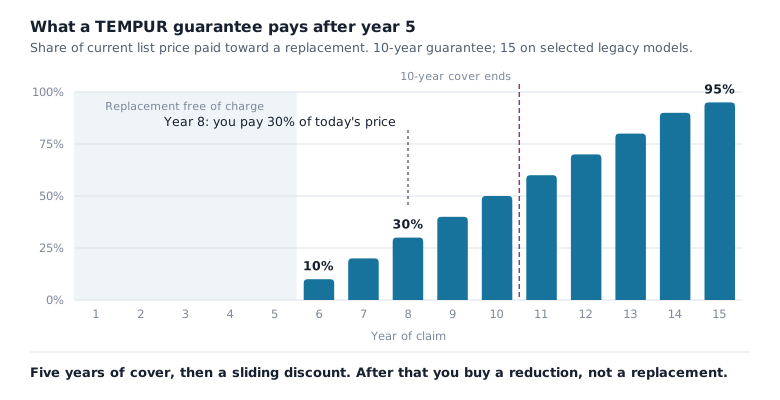
Claim in year six and you pay 10%. Year eight, 30%. Year twelve, 70%. By year fifteen the guarantee is worth 5% off a new mattress.
Note the base for that calculation: the current list price. Mattress prices rise. A guarantee that pays 50% of a more expensive mattress in ten years’ time is worth less than it sounds even at the halfway point.
TEMPUR’s cover is genuinely excellent for five years and then becomes a loyalty discount. That is not a criticism of the product — five years of full cover is more than many brands offer. It is a criticism of describing it as a ten or fifteen year guarantee without qualification.
How deep does the dip have to be?
This is the question that decides most claims, and there is no shared answer.
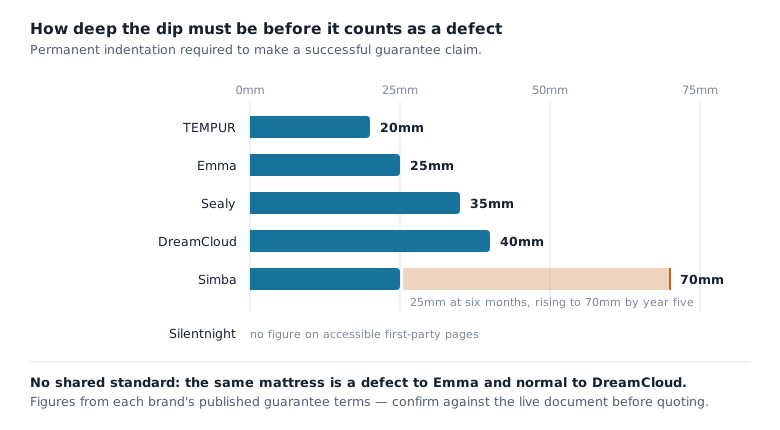
TEMPUR acts at 2cm. Emma at 2.5cm. Sealy at 3.5cm. DreamCloud at 4cm. The same physically sagging mattress is a defect to one manufacturer and normal wear to another.
Simba does something different again. Its threshold climbs with the age of the mattress: 25mm in the first six months, 30mm to a year, 35mm to two years, 40mm to three, 45mm to five — and 70mm from year five to year ten.1 Seventy millimetres is roughly the depth of a clenched fist. A mattress can be visibly sagging and thoroughly uncomfortable at 40mm in year six and still be performing as designed.
The effect resembles a pro-rata scale by another route: the guarantee runs the full ten years, but the bar for a successful claim rises with it. Simba does not describe it that way, and a rising threshold is defensible on its own terms — some settlement genuinely is normal, and more of it is normal at year eight than at six months. The question is whether 70mm is the right number, and nothing published lets an outsider judge that.
Brands do not reliably publish thresholds on their guarantee pages. Emma’s 2.5cm is in section 19.3(b) of the terms and conditions; the guarantee marketing page carries no figure. Sealy’s 3.5cm is on its caring for your mattress page. If you cannot find a threshold, check the T&Cs and the care pages before concluding there isn’t one.
We could not find any threshold for Silentnight on a reachable first-party page. That is reported as not found, not as absent.
The exclusions that end claims
Near-universal across every set of terms we read.
- Stains and soiling. TEMPUR excludes a mattress that is “very stained, soiled and/or otherwise unhygienic”. DreamCloud lists “burns, cuts, tears, liquid damage, or stains”. One spilled drink can end a ten-year guarantee on the first night, which makes a protector the cheapest insurance in the bedroom.52
- The wrong base. Slat gap maximums differ by brand: Sealy 7.5cm, Simba under three inches, DreamCloud and Nectar 9cm. A base compliant for one voids another, and in our experience it is rarely raised at the point of sale.6
- Failure to rotate. Simba requires monthly rotation for three months then quarterly; OTTY states plainly that failing to rotate “might invalidate your warranty”.7 Worth noting the practical difficulty: few owners keep a record of rotating a mattress, so this is a condition most people would struggle to demonstrate they had met.
- Exceeding a stated weight limit. Simba lists “use by any individual weighing more than 18 stone (114kg)” as grounds to reject a claim.1 Not every brand publishes a limit; check rather than assume.
- Turning a single-sided mattress. Sealy lists “single-sided mattress used on underside” as a voiding condition.
- Re-rolling a bed-in-box. The NBF is explicit that bending or rolling permanently damages the spring unit and invalidates the guarantee — worth knowing before you move house.3
- Second-hand ownership. Sealy and DreamCloud guarantees are non-transferable. An inherited mattress has none.
- No proof of purchase. Universal.
The American “do not remove under penalty of law” tag has no UK equivalent, and removing a label here breaks no law you can be penalised under. But it carries the batch and product identification the manufacturer needs to work out what you own. Leave it on, photograph it, and keep the receipt somewhere you will still find it in eight years.
Your rights are separate, and better
This is the part worth knowing above everything else on this page.
Under the Consumer Rights Act 2015 your statutory rights are against the retailer who sold it to you — not the manufacturer whose name is on the guarantee. The official Trading Standards guidance is explicit that a trader “cannot deny a consumer their statutory rights and direct them instead to their rights under the guarantee or warranty”, and that an expired guarantee does not mean expired statutory rights.8
Retailers routinely deflect faults to the brand. They are not entitled to.
| Window | What applies |
|---|---|
| First 30 days | Short-term right to reject — full refund. You must show the fault exists and was present at delivery |
| 31 days – 6 months | Burden of proof reversed. The fault is assumed present at delivery unless the trader shows otherwise. One repair or replacement, then a price reduction or final right to reject |
| 6 months – 6 years | Burden returns to you; usually needs an independent inspection report. 5 years in Scotland |
Two things people get wrong about the six years. It is a limitation period for bringing a claim, not a six-year guarantee — you must still prove an inherent defect present at delivery, and a mattress that simply wore out is not a claim. And under section 24(8), a refund after the first six months may be reduced to account for the use you have had, which after several years is substantial.9
So: full refund in year eight?
No, and it is worth being blunt about why, because this is the question people actually arrive with.
Under the guarantee: the best realistic outcome is a replacement mattress, not money. With TEMPUR you would pay 30% of today’s price toward it. With Simba the dip must reach 7cm first. With most brands, a mattress that has simply gone soft, or has impressions below the threshold, is not defective at all — it is working as designed. And a single stain can end the claim outright.
Under the Consumer Rights Act: year eight is outside even the six-year limitation period in England and Wales. Had you been inside it, past six months you must prove the fault was inherent from delivery, and any refund is reduced for the use you have had.
A ten-year guarantee is a ten-year promise against manufacturing defects. It is not a promise that the mattress will still feel good, and nothing in UK law or in any of these documents entitles you to your money back in year eight.
How to compare guarantees properly
Three questions, none of which appear on a swing ticket.
- How deep must the dip be? The single most decisive number, and it ranges from 2cm to 7cm.
- Is the payout pro-rata? A full replacement is worth several times a sliding discount.
- What voids it? Base type, stains, rotation, weight limits, registration.
On those terms a five-year guarantee with a 2cm threshold and full replacement beats a ten-year one needing 7cm and paying pro-rata — comfortably. The headline number tells you almost nothing.
Guarantee terms change. Every figure here was taken from the brand’s own UK pages on 29 August 2026. Dreams’ own guarantee terms could not be retrieved; it sells third-party brands, so the manufacturer’s terms are the ones that govern. If a figure matters to a purchase, open the brand’s current document and confirm it.
The full set of figures, including trial lengths and slat requirements, is collected on the UK bed facts page. The practical version is in twelve buying mistakes.
References
- Simba. 10-year mattress guarantee. simbasleep.com/pages/guarantee-mattress
- DreamCloud UK. Warranty. dreamcloudsleep.co.uk/pages/warranty — Nectar UK trades under identical terms.
- National Bed Federation / Bed Advice UK. Caring for your bed, and mattress settlement and body impressions. bedadvice.co.uk — a trade body representing bed manufacturers; its framing is congruent with its members’ interests, though the underlying point about filling settlement is sound.
- Hypnos. Bed Care Guide & Guarantee, May 2023 (Issue 2). hypnosbeds.com — Hypnos’s own document. “Register now to activate your complimentary 10 year Guarantee”; “any claim must be submitted in writing by the original purchaser to the supplying retailer within one month of the apparent defect becoming evident”. Checked 29 August 2026.
- TEMPUR UK. Quality guarantee, and the linked UK-en TEMPUR Flagship Guarantee & Instructions for Use (June 2024). uk.tempur.com/quality-guarantee.html — 10-year headline; pro-rata contribution from year 6 (10% of current list price, rising annually); defect defined as a visible indentation greater than 2cm in the TEMPUR material. Checked 29 August 2026.
- Sealy UK guarantee information and Caring for your Sealy. sealy.co.uk/guarantee-information · sealy.co.uk/caring-for-your-sealy
- OTTY. Aftercare. otty.com/pages/aftercare
- Chartered Trading Standards Institute. Consumer Rights Act: goods guidance for business, September 2015. businesscompanion.info
- Consumer Rights Act 2015, section 24. legislation.gov.uk/ukpga/2015/15/section/24
- Emma UK. Terms and conditions, section 19.3(b), and 10-year guarantee. emma-sleep.co.uk/terms
- Silentnight. Guarantees. silentnight.co.uk/help/guarantees